
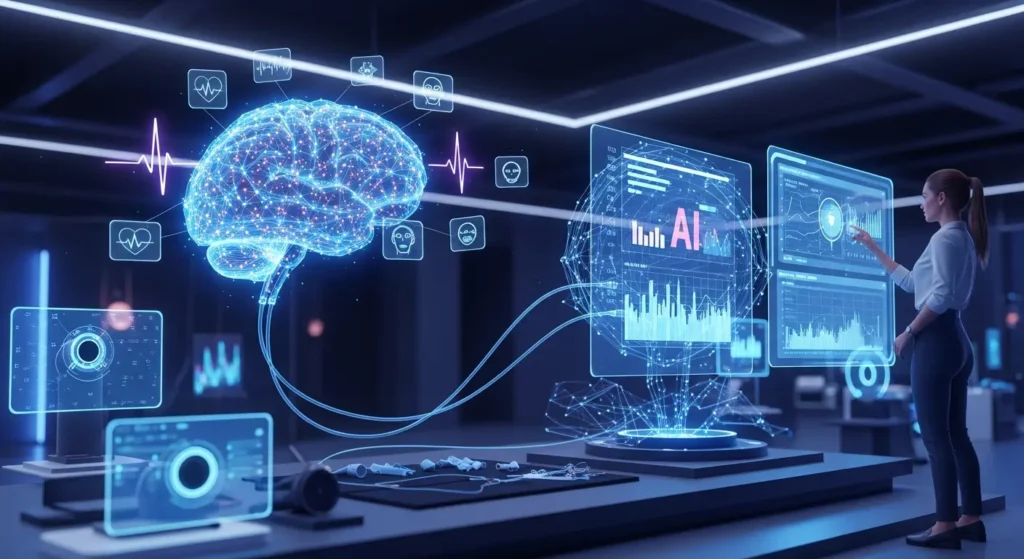
As our digital world keeps moving on, businesses can’t rely on traditional marketing alone to connect with people. Customers don’t just buy a product they buy emotions, experiences, and trust. This is where Neuromarketing and AI are transforming how brands understand people at a deeper, psychological level. By combining the science of the brain with the power of artificial intelligence, companies can decode what customers feel, not just what they say. And in a competitive, technology driven market like India, this fusion is becoming a game changer.
Neuromarketing combines psychology, neuroscience, and behavioral analysis to understand how customers respond emotionally to ads, products, packaging, branding, and digital experiences. Instead of guessing what people like, neuromarketing tracks real, unconscious reactions, eye movements, facial expressions, tone changes, heart rate spikes, and emotional triggers.
This helps companies answer questions like:
In the digital age, understanding these insights is essential. People scroll fast, judge instantly, and expect brands to connect on a personal level. That’s why Neuro marketing in the digital age has become one of the most powerful tools for creating meaningful customer experiences.
Here’s how AI works inside the neuromarketing ecosystem:
1. AI Reads Human Emotions Through Data
Using algorithms, AI scans micro expressions, voice tone, click behavior, or even brainwave patterns. This helps in Evaluating consumer emotions with scientific precision.
2. Helps Brands Predict What Customers Will Feel
AI learns emotional patterns of stress, excitement, curiosity, fear of missing out, and satisfaction. This helps brands craft campaigns that truly resonate.
3. Improves Marketing Personalization AI in neuromarketing allows businesses to deliver highly targeted content based on emotional responses boosting conversions without being intrusive.
4. Aligns Product Experience With Real Emotions
Whether it’s an app, website, or video ad, AI tools highlight the exact points where customers feel frustrated, happy, or confused. This creates a foundation for AI marketing psychology that improves customer satisfaction.
Today, consumers make emotional decisions first and rational decisions later. A brand that understands and respects emotional patterns wins trust faster.
Here’s why emotional analysis is crucial:
By mastering understanding consumer emotions, brands can improve their storytelling, refine their messaging, and create digital experiences that feel natural, comforting, and relatable.
Here’s how Neuromarketing and AI reshape modern marketing:
1. Real-Time Customer Emotion Analysis
AI-powered systems can track how customers emotionally respond to content as they scroll, swipe, or watch. This level of customer emotion analysis makes marketing more accurate and human-centered.2. Smarter Ad Creation
AI learns which emotional triggers improve engagement hope, excitement, trust, curiosity, humor, or empathy. Brands can use this data to design high-performing video ads, banners, and product descriptions.
3. Better Website & App Experience
Neuromarketing tools identify friction points:
Which section confuses users?
Where do they hesitate?
Which button placement feels natural?
Fixing these emotions driven friction points boosts conversions.
4. Emotion-Based Personalization
Instead of generic recommendations, AI provides emotion-sensitive suggestions like:
Customers feel understood, not targeted.
One fear people have is that AI makes marketing “robotic.” But the truth is the opposite. Neuromarketing helps brands become more human by understanding real emotional needs.
A humanized approach includes:
When AI and neuromarketing are used ethically, they build deeper emotional loyalty and brand trust.
Better Customer Understanding
More Accurate Marketing Strategies
Higher Conversion Rates
Reduced Marketing Waste
Enhanced Customer Loyalty
1. Digital Advertising Campaigns
Predict which content will emotionally attract your audience.
2. Website & App Optimization
Improve UX based on emotional reactions.
3. Product Packaging
Understand which colors, shapes, and layouts evoke positive responses.
4. Brand Storytelling
Craft stories that emotionally resonate with customers.
5. Social Media Engagement
Create content that feels relatable, empowering, or inspiring.
As AI evolves, emotional intelligence in marketing will become even more powerful. Future tools may decode deeper emotional layers, predict buying patterns, and help brands connect at a human, psychological level.
The future of marketing belongs to brands that understand the emotional pulse of their audience and deliver value with empathy, creativity, and technology.
Neuro Marketing + AI is not just a trend, it’s the future of customer centered marketing. By combining neuroscience, psychology, and artificial intelligence, brands can create meaningful emotional experiences that customers remember and trust.
From Evaluating consumer emotions to building emotionally intelligent campaigns, AI in neuromarketing gives businesses a new advantage, one that feels personal, intuitive, and deeply human.
If brands want to stay relevant in the digital age, understanding consumer emotions through AI driven neuromarketing is the smartest move forward.
📈 Master SEO, Google Ads & Social Media
🎓 Learn directly from industry experts
🛠️ Work on hands-on projects
💼 Earn a recognized certificate




Neuromarketing is a modern approach that blends neuroscience with marketing to understand how people make buying decisions. With AI in neuromarketing, brands can analyze emotional responses faster and more accurately, helping them create campaigns that truly resonate.
Neuromarketing combines psychology with advanced tools like AI, eye tracking, and facial emotion analysis. This mix helps businesses discover what really influences customers on a subconscious level.
When people ask how AI functions in neuromarketing, the answer is simple, AI processes emotional cues, behavior patterns, and reactions in real time. This allows brands to predict what customers will feel or do next.
Understanding consumer emotions is key because most buying decisions are emotional before they are logical. When brands tap into true feelings, they create stronger connections, trust, and loyalty.
AI helps with evaluating consumer emotions through tools like facial recognition, sentiment analysis, and biometrics. These insights reveal whether customers feel excited, confused, or disengaged during an ad or digital experience.
Neuro marketing in the digital age is crucial because customer attention spans are shorter than ever. AI technology helps identify which visuals, messages, or experiences instantly capture attention and which ones fail.
AI isn’t perfect, but today’s systems are highly trained to read subtle cues like tone, micro expressions, and online behavior. This makes customer emotion analysis more accurate than traditional surveys alone.
Businesses use neuromarketing and AI to refine their ads, website design, product packaging, and customer journeys. The combination helps eliminate guesswork and rely on actual emotional data.
Industries like retail, healthcare, entertainment, real estate, and e-commerce benefit greatly because they rely heavily on emotional engagement and customer experience.
AI marketing psychology can be ethical when used responsibly. Good brands use emotional insights to improve customer experiences, not manipulate them. Transparency and consent are key.
© 2025 Akasa Institute (A Unit of Akasa Unitech Pvt. Ltd.). All rights reserved.